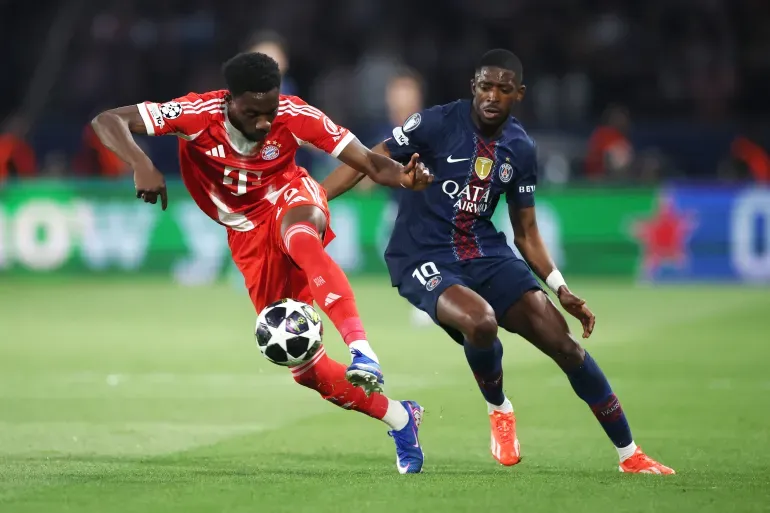
Paris Saint-Germain travel to Munich carrying a slender 5-4 advantage over FC Bayern Munich ahead of a highly anticipated second leg of their UEFA Champions League semifinal. The opening encounter delivered one of the most electrifying matches in modern European football history, becoming the highest-scoring semifinal first leg ever recorded in the competition. With both managers signaling an attacking approach once again, expectations are rising for another tactical and emotional spectacle. Beyond sporting significance, the contest also reflects the commercial magnitude of elite European football, where global broadcasting revenues, sponsorships, and legacy-defining success increasingly shape club strategy and financial ambition.
Europe Braces for Another High-Stakes Football Spectacle
The UEFA Champions League has long been defined by nights of drama, tactical brilliance, and elite individual performances. Yet even by those standards, the first-leg clash between Paris Saint-Germain and Bayern Munich exceeded expectations.
The nine-goal thriller produced relentless attacking football, defensive vulnerability, and moments of individual brilliance that transformed the contest into an instant European classic. By the final whistle, PSG had secured a narrow 5-4 advantage, but the scoreline left the semifinal delicately balanced ahead of the return leg in Munich.
Football analysts across Europe described the encounter as one of the greatest semifinal matches in Champions League history, not merely because of the volume of goals, but because of the intensity and fearless tactical approach adopted by both sides.
Now, with a place in the final at stake, anticipation surrounding the second leg has reached extraordinary levels.
Attack Over Caution Defines Modern European Football
What made the first encounter particularly remarkable was the willingness of both teams to prioritize aggressive attacking play over tactical conservatism.
In high-pressure knockout football, managers often rely on defensive structure and controlled possession to minimize risk. Instead, PSG and Bayern embraced open transitions, high pressing, and relentless forward movement, allowing some of the world’s best attacking players to operate with unusual freedom.
The result was a match that reflected a broader transformation in elite European football, where attacking entertainment increasingly aligns with commercial incentives and global audience expectations.
Both managers have indicated they will maintain a similarly aggressive tactical approach in Munich, despite the enormous stakes involved. That decision suggests neither club intends to retreat into defensive caution, potentially setting the stage for another emotionally charged encounter.
From a strategic perspective, the willingness to continue attacking also highlights the confidence embedded within both squads’ offensive depth.
PSG Pursue Validation of Their European Project
For Paris Saint-Germain, the semifinal carries significance far beyond a single result.
The club’s ownership structure and long-term investment model have been built around one central objective: securing UEFA Champions League success. Over the past decade, PSG have invested billions of rupees equivalent in transfer fees, salaries, infrastructure, and commercial expansion to establish themselves among Europe’s elite football institutions.
Domestic dominance in France, while commercially valuable, has never been viewed as the ultimate benchmark for the club’s leadership. European success remains the defining measure of whether the project can be considered historically successful.
A victory over Bayern Munich would bring PSG another step closer to achieving the continental legitimacy that has often eluded them despite their financial power.
The club’s current squad reflects a more balanced sporting structure compared to earlier eras heavily dependent on individual superstardom. Analysts believe that tactical maturity and collective cohesion have become increasingly visible within the team’s European performances.
Bayern Munich Seek to Reassert Continental Authority
For Bayern Munich, the semifinal represents an opportunity to reaffirm their enduring status as one of Europe’s most stable and respected football institutions.
Unlike clubs driven primarily by aggressive external investment, Bayern’s model has historically emphasized financial discipline, sustainable growth, and long-term organizational continuity. The German champions remain one of the most commercially efficient clubs in global football, consistently combining profitability with elite sporting performance.
However, European success is essential to preserving Bayern’s global influence and commercial stature.
Modern football economics are heavily tied to Champions League performance. Deep tournament runs generate substantial revenues through broadcasting rights, sponsorship activation, ticketing, merchandising, and international brand exposure. Failure at this stage would not merely represent a sporting disappointment — it would also affect competitive positioning in football’s increasingly aggressive commercial landscape.
Consequently, Bayern are expected to approach the second leg with the same attacking urgency displayed in Paris.
The Champions League’s Expanding Commercial Gravity
The semifinal also underscores the extraordinary financial ecosystem surrounding elite European football.
The UEFA Champions League has evolved into one of the world’s most lucrative sporting competitions, generating billions in annual revenues through global media rights, sponsorship agreements, and digital engagement. Clubs competing at this stage are not only battling for trophies, but also for economic influence, market visibility, and long-term brand equity.
Matches of this scale attract massive international audiences and significantly influence club valuation, sponsorship negotiations, and global fan acquisition strategies.
The PSG-Bayern rivalry particularly embodies modern football’s economic transformation. On one side stands PSG’s state-backed expansion model focused on rapid global branding; on the other stands Bayern’s institutionally disciplined structure rooted in financial sustainability.
Their semifinal therefore represents more than a tactical battle — it symbolizes two distinct philosophies competing within the modern football economy.
Munich Awaits Another Defining European Night
With only a single goal separating the teams, the second leg promises to deliver another intense and unpredictable contest.
PSG’s narrow advantage offers no meaningful security against a Bayern side renowned for its attacking power and home dominance. At the same time, the French club’s offensive quality ensures that Bayern cannot afford to overcommit recklessly without exposing defensive vulnerabilities.
The tactical tension between aggression and control is likely to define the evening.
For supporters, broadcasters, and football executives alike, the match represents precisely the kind of elite spectacle that continues to elevate the Champions League’s global commercial and cultural appeal.
As Europe prepares for another dramatic semifinal night, one reality remains clear: after producing one of the competition’s greatest first-leg encounters, PSG and Bayern now carry the burden — and opportunity — of attempting to surpass it.
Comments